
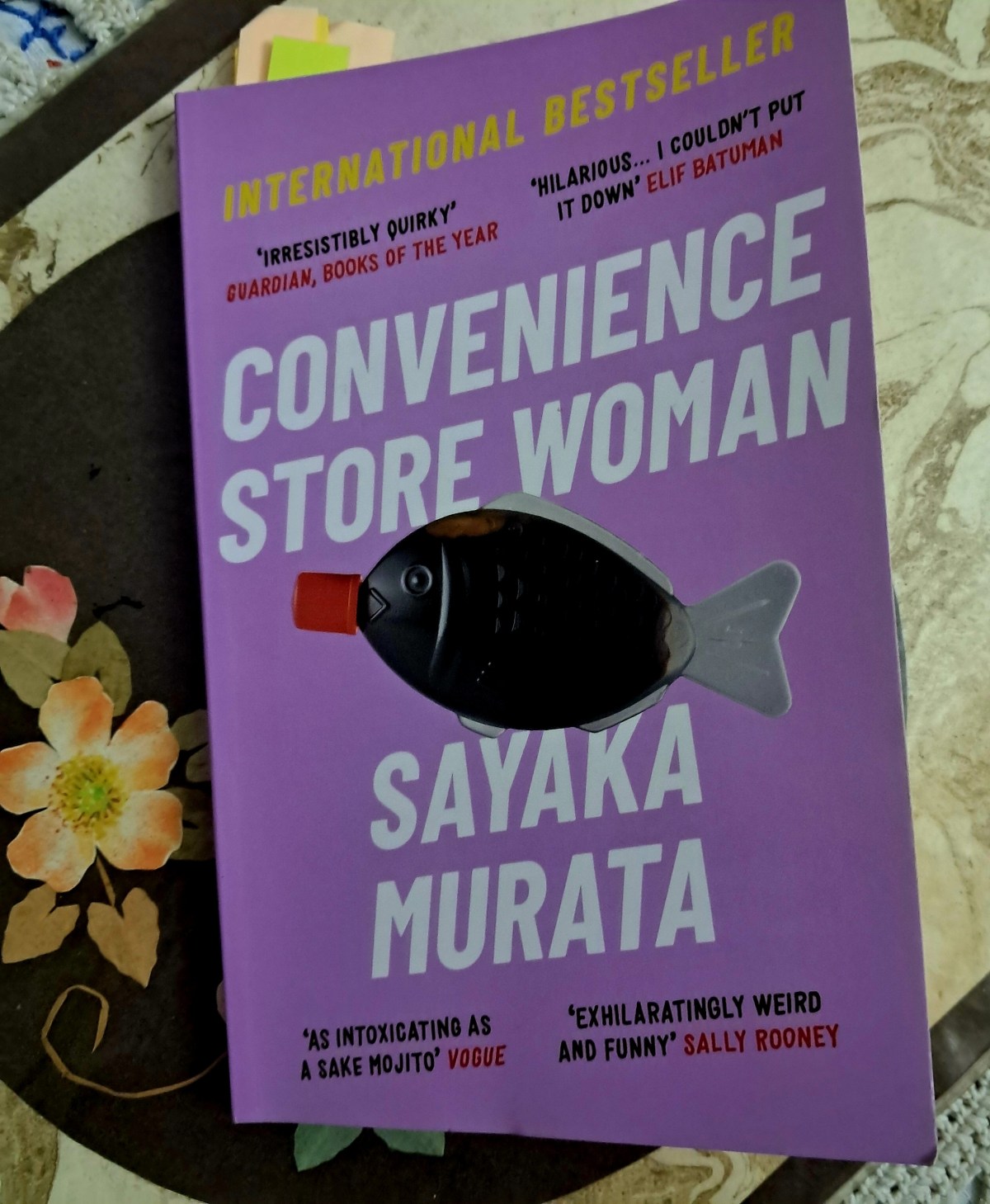
Exploring Identity in Sayaka Murata’s Convenience Store Woman

How do you survive in a society you are not built for? This is the question that Japanese author Sayaka Murata asks in her novel Convenience Store Woman (2018).

Sayaka Murata

How do you survive in a society you are not built for?

Convenience Store Woman (2018) by Japanese author Sayaka Murata (trans. Ginny Tapley Takemori) takes this question head on. This is a short, slim and extremely readable novel with a racy style and an aestheticised deadpan humour (so Japanese!) and is quite bewildering. This novel is a first-person account of a 36-year old woman Keiko Furukura who has been working part-time in the same convenience store in modern-day Tokyo for 18 years. The writer herself also worked at a convenience store for 18 years until this novel brought her fame and allowed her to pursue writing full-time.

Keiko has always been different. Her parents try to ‘cure’ her, her sister comes up with excuses she can use in socially-awkward situations in order to help her come across as an emotionally intelligent human. Keiko learns that keeping “her mouth shut was the most sensible approach to getting by in life” and grows into adulthood as the epitome of a self-effacing people-pleaser. She observes, astutely analysing, commenting and adopting the script of ‘normal’ people in order to survive. Some of her insights are trenchant remarks on the behaviour around her: “I’d noticed soon after starting the job that whenever I got angry at the same things as everyone else, they all seemed happy…I pulled off being a person” or “When something was strange, everyone thought they had the right to come stomping in all over your life to figure out why. I found that arrogant and infuriating, not to mention a pain in the neck” or that being an adult meant “having crow’s feet, talking in a more relaxed manner, and wearing monotone clothes” or that “the normal world has no room for exceptions and always quietly eliminates foreign objects. Anyone who is lacking is disposed of.” 

“The truth that is beyond what people read as the truth. The real truth that is hidden under a lid and has not yet become words. I’ve wanted to see this ever since I was a child. [..] When I write my stories I am being pulled around by them. I never know where the story will take me. Someday I want to get to what is deep down in people. Not so much what people believe to be- but rather something you try not to see. Something that will be dangerous to put into words.”

Sayaka Murata 

The Convenience Store as a Haven of Humdrum

The convenience store offers Keiko a controlled environment in which you just wear a uniform and do as the manual says. “As long as you wear the skin of what’s considered an ordinary person and follow the manual, you won’t be driven out of the village or treated as a burden. You play the part of the fictitious creature called ‘an ordinary person’ that everyone has in them. Just like everyone in the convenience store is playing the part of the fictitious creature called ‘a store worker’.” Belonging becomes her biggest sense of achievement as she takes pride in being ‘a cog in society.’

Murata’s work has struck a deep chord with sexual minority groups and ‘divergent’ communities who have found solace in her work and the way that it describes  their everyday struggle to conform to society’s long list of expectations from gender roles, status, marriage, to ideas of success and the well-lived life. Although several reviewers have also talked about Keiko’s neurodivergent tendency in misreading social cues and her learned behaviour in order to survive and how that relates to the challenges of conditions like autism or ADHD, the novel does not explicitly address these. A perspective that isn’t sufficiently discussed is that of Keiko’s struggles and lived experience as a single woman in her late 30s navigating a society in which “you have no value unless you are married or have a career.” Keiko is a woman without the ambition to move up the social ladder or to reach life goals such as marriage or kids and finds her ultimate purpose and fulfillment in the familiar and comforting space of a convenience store as that seems to be the only thing she can do, and do very well. Her entire character arc goes from being an incorrigible people-pleaser, absorbing speech cadences, dressing and make-up styles from those around her to having her own epiphany: “I realize now more than a person, I’m a convenience store worker. Even if that means I’m abnormal and can’t make a living and drop down dead, I can’t escape that fact. My very cells exist for the convenience store.”

Key themes and Insights

This is a novel that upends notions of selfhood, independence, empowerment and also resilience. Keiko’s quiet resilience in continuing to live her non-descript and mundane life that no one around her understands is valuable in itself for her. The author defies the reader to judge her, to feel sorry for her and to pity her only to realise that there is more than meets the eye. In her cheat codes for survival, Keiko is smarter than we care to acknowledge and has the courage to embrace the only path that is truly available to her. Is this also not what the stoics tell us to do? Even if this path of individuality is to be found at the alter of robotic consumerism. In this web of contradictions, is this obsession with the convenience store an ode to modernity? Is Keiko, after all, the ideal worker in a capitalist system as she eats, keeps her body fit and gets enough sleep only to be able to work again? Or is she a woman who chooses to remain in the safety of an environment she can fit in to survive in a society that she isn’t built for? The only truth that Murata seems to hint at is that unlike everything else, resilience does not have a script. It is not always loud and can also exist in this way- invisible, light-footed, compliant yet non-conforming. 

El Supplente (The Substitute) and What is Literature For?

I resurface on this blog after an eternity. But I saw a film recently that made me want to sit up and write. Since many months, and through the course of my own teaching, I have felt that literature as a discipline and the humanities more generally are dying a slow death. This may be a controversial statement and there could be many to contest it, but the way we read and consume literature is not the same as we used to even a decade back. With the advent of the Kindle and social media and ubiquitous gadgets and the insta culture, we no longer have the leisure or the capacity to read, to savour an experience and to even tell or listen to stories the way we used to. Students just don’t read anymore. This has been extensively written about in the US and maybe here in India reading is not that easily done away with but certainly one sees a change in attention spans. But my concern here is not only reading but specifically the role of literature as a discipline. It seems to me that now more than ever we are called to justify its purpose in a social environment and culture where it appears to be increasingly obsolete.

In one of the scenes of the Diego Lerman-directed Argentinian film El Supplente (The Substitute, 2022), a sophisticated literature professor Lucio finds himself in the daunting task of teaching a class of disinterested and irreverent students in dusty, suburban Buenos Aries. “What is literature for?” He asks his students on his first day of class. “To make us sleep” says one adolescent, while another dozes at the back. “I don’t read” confesses another. “To tell stories.” “Literature is of no use to us.” The look on the professor’s face tells us how difficult it is for him to circle back to a question that he has taken for granted in his intellectual pursuits. His plight in bridging this gap also becomes the journey that he embarks on in connecting with his students and understanding the context of their difficult lives- lives that are caught in the crossfire of state violence and local druglords (reminiscent of Freedom Writers in so many ways). “What is literature for” seems even more difficult to answer when schools are unsafe spaces, where police machinery can barge in to do drug checks and arrest minors without following protocols of minor rights, where hospitals are unsafe and patients who seemed to be doing well, mysteriously deteriorate and even die. What use of is literature in places wired for survival, surveillance and violence? Can one have the leisure to sit and read and talk about feelings? To talk about the nuances of paradox, metaphor and simile? To discuss genres, styles and canon? It seems a tasteless luxury, an outlandish hobby.

Although I am fortunate enough to not face the perilous environment of Lucio and his students, the question “What is literature for”? is still not easily answered. More so, when people still look for tangible results, concrete life-changing metrics and quantifiable returns. Literature is of no use in that sense. Justifying the discipline at the level of an educational set-up especially when competing with other quantifiable disciplines is one thing. But increasingly one finds that there is a dissociation between discipline and the values that were once taken for granted to be a part of it. Literature was for building character, for cultivating human values and empathy, for understanding the human condition in its beauty and terror, for making sense of one’s own journey, for understanding the frailty of human morality, the violence of the human heart and mind. To understand the expanse of that endeavour, required if not leisure at least deliberate thought, pause and reflection. This was certainly not a luxury. It was the characteristic of an inquisitive and balanced mind. But today being called to justify the purpose of this discipline speaks both of the erosion of those values as well as the changing cultures of intellect and what we hold in prestige today.

As Lucio becomes more and more a part of his community, shares the grief of losing his father, saves one of his students from a druglord, he becomes less interested in asking his students what literature is for. Instead in one of the final scenes, he brings a chart with the figure of the human body and asks the students to identify different parts. Once they do that, he points: “Now show me where the soul is” The students reply that it is not visible. “When we use phrases like ‘It hurts my soul’ what do we mean?” asks the professor. “It hurts in places you cannot see.” says one student. “that feeling is beyond pain,” offers another. “It hurts me to pieces.” “I love you with my soul.” “It is underlying, inexplicable.” The dozing kid is wide awake now. The question ‘What is literature for?’ is suddenly redundant.

Tristram Shandy

A write-up on Laurence Sterne’s landmark novel Tristram Shandy published in the eighteenth century and marked by digression, double entendre, problems of language and graphic devices.

Laurence Sterne’s ‘novel’ Tristram Shandy, born in the latter part of the eighteenth century, found itself in a waning tradition of biting satire of the kind earlier propagated by Pope and Swift. Although it is itself clearly a satire, through its meandering in and out of “scintillating wit and whimsical baffoonery” (Stedmond, 53), Tristram Shandy is nevertheless much more good-humoured than its predecessors. Even its profuse bawdy humour that presents itself almost naively throughout the novel, prompted Samuel Johnson to respond with “Nothing odd will do too long.”

And yet, two and a half centuries later, Tristram Shandy came to be widely regarded as the godfather of modernist literature. Sterne’s wild experimentation with form and voice was a radical departure from the orderly, structurally unified novels of the day, such as Fielding’s Tom Jones, and considerably ahead of its time. Sterne’s childhood was spent following his father’s army regiment around England and Ireland. This early experience of military life was to inspire some of his most memorable comic characters, including the war-game obsessed Uncle Toby and Corporal Trim. The satirical and stylistic influence of Rabelais and Cervantes can also be felt throughout Tristram Shandy, whilst the philosophy of John Locke informs one of the book’s key themes: the association of ideas.

The protagonist’s constant straying away from the story, if it could be called a story at all, switching back and forth in time, the smallest of trivialities or comical accidents triggering off the most outrageous fabrications, all contribute to render Tristram Shandy, a novel of digressions rather than of narrative. “Digressions, incontestably, are the sunshine; – they are the life, the soul of reading! – take them out of this book, for instance,- you might as well take the book along with them” (50). And it is in this digression that the novel retains its uniqueness, a uniqueness upon which the author had long deliberated rather than stumbled upon. Thus although the author constantly laments having so much yet to write about, he still cannot check himself from straying into apparently irrelevant incidents. There is an implicit sense then, of the futility of recounting in the first place. This futility of communication seems to occur, not because of a lack of means but because the author takes on the impossible task of writing about his life while living it.

The central irony of the book is that the novel is being written more slowly than the life that is being lived, that while Tristram sits down to pen an incident, he nevertheless lives in a continuum of space and time and his experience keeps accumulating thus always adding to what he has to write.

Through this sort of hermeneutics, Sterne also seems to throw light on the complexity of human beings which are, like Tristram, brought into society by accident, or even through a process so mechanized and regulated that there is almost nothing human about it as suggested in the opening scenes with the winding of the clock. After being thus ejected into the world, human beings have to further undergo the trauma of baptism in order to exist and own an identity. It is Walter Shandy’s “magic bias” that will decide the character of his son through a name. But, Tristram is in fact a victim of several accidents, the biggest of which is probably his birth as not only is he mis-named and de-sexed in the novel, he appears, rather than the protagonist, more as a minor character or narrator whose voice is subordinated to the description of the other characters.

Tristram in the novel is in fact nothing more than a voice and yet it is Yorick that the author speaks through, deserting Tristram almost as cruelly as he does the other characters. The narration of the story is futile not because of the narrator’s continuous existence, but because of the characters in his world who are immune to him even in moments of severe crisis. This was the case when the maid and Dr Slop are trying to attend to Tristram after the window sash incident but fall to quarreling among themselves, leaving Tristram by the wayside. Everyone rides his hobby-horse and thus, not only is there no one to be part of the Tristam’s story, there is no one to listen to him as well. He is himself, like the rest of his characters, riding his own hobby horse of trying to recount a story that is never going to end.

This is where Sterne seems to equalize all his characters and allay a little bit of Tristram’s victimhood in a world in which everyone spins in his respective orbit but nevertheless in the gravitational field of the other. In a tower of Babel-like situation, everyone simultaneously talks about his own life and opinions in a desperate need to be understood and in the end, the confused hodgepodge of voices that is heard is not very different from the narrative chaos that undermines every attempt of Tristram to begin at the beginning. “Tristram Shandy is quintessentially a book about man’s attempt to give a reasonable and definitive form to his experience of the world-and about the inevitable tendency of experience to run counter to man’s formulations” (Briggs, 195).

Upon closer inspection, the narrator’s statements about narrating what he is doing and when he is doing it are seen as somehow “above or beyond the plot, as if these were outside the domain of the narrative proper- as if they existed as critical comments on narrative rather than as part of the narrative itself” (Williams, 1032). The narrator always freely shifts positions. He is self-reflexive in the way that he is aware that he is recounting his life ‘story’ and at the same time keep reminds us about it too. Unlike the self-effacing omniscient narrator, the self-conscious narrator of Tristram Shandy flaunts his whims and narrative agency to the reader. He can have a marbled page in the middle of the novel if he likes, he can have absurd patterns of asterisks or of any other typing symbol that he likes, he can even pretend the novel was suddenly a play and give stage directions to Garrick.

If he chooses, he can refrain from description altogether, then the reader might be at sea when it comes to certain events like the window sash circumcision: “It is in vain to leave this to the reader’s imagination” (377). This kind of narrator is then enormously powerful. Not only does he provide the narrative, but admits that he is as fallible as us, as ignorant. The reader’s interpretation is as biased as the narrator’s. There is no pretension of objectivity or reality. As the title itself spells out, the novel is not just about the life of Tristram Shandy, it is also about his opinions. Any act of narration is necessarily also interlinked with the act of sentience. To ‘be’ is necessarily tangled with the activity of explaining being.

In as much as Tristram may be considered as rhetor, the whole book consists of his “oration.” But this is the rhetoric of a “fool.” And it carries some interesting implications about Sterne’s conception of the nature of his audience. Like Swift in The Modest Proposal, he shocks the more squeamish members by reflecting upon their own underlying preconceptions. One kind of empty verbalism against which both Swift and Pope inveighed was the fulsome praise of the prospective patron. Sterne’s dedication of his first volume to Pitt is, significantly, not fulsome. Sterne was of course seeking a patron of a different kind-the reading public at large. He implicitly dedicates his book to them by titillating their tastes, while at the same time managing to satirize the human foibles involved in that taste. Thus, though dedicating his book to the “Lord Public,” he attempts to unseat that Lord from some of his “Hobby-Horses,” or at least to make him more aware of his “ruling passions.”

“With an ass,” Tristram says in his account of his travels in Volume VII, “I can commune forever.” Not so with jackdaws or apes, for they speak and act by rote. But with an ass, “surely never is my imagination so busy as in framing his responses from the etchings of his countenance-and where those carry me not deep enough-in flying from my own heart into his, and seeing what is natural for an ass to think-as well as a man, upon the occasion” (VII. xxxii.). The reader whose responses Tristram can gauge as accurately as he can those of an ass is one who will laugh at certain words in the bedchamber, but abuse them in the parlor. For his sake, Tristram must seek devices whereby he can “satisfy that ear which the reader chuses to lend me,” while not dissatisfying “the other which he keeps to himself” (VII. xx.).

Works Cited

Briggs, Peter M. “Locke’s ‘Essay’ and the Tentativeness of ‘Tristram Shandy’.”
Studies in Philology, Vol. 82, No. 4 (Autumn, 1985), pp. 493-520.

Stedmond, J. M. “Satire and Tristram Shandy.”Studies in English Literature, 1500-1900, Vol. 1, No. 3, Restoration and Eighteenth Century,(Summer, 1961), Rice University, pp. 53-63.

Williams, Jeffery. “Narrative of Narrative (Tristram Shandy).”MLN, Vol. 105, No. 5, Comparative Literature (Dec., 1990), The Johns Hopkins University Press, pp. 1032-1045.